
Making Exercise Work Beyond the Clinic
Case Studies: Singapore & Bangkok
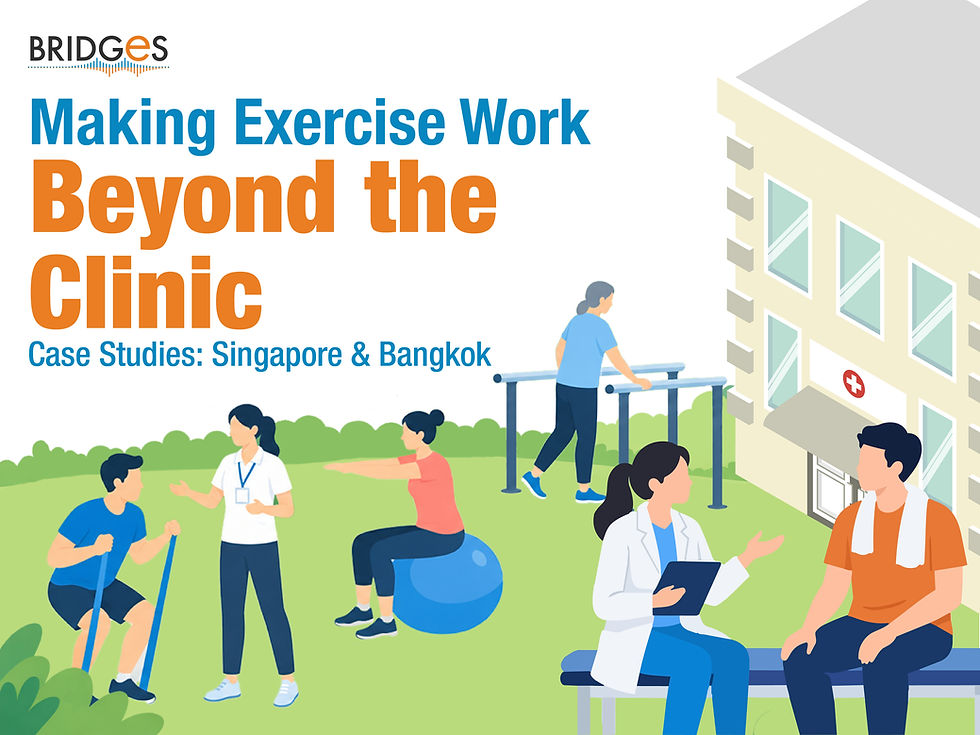
Singapore and Thailand are rethinking exercise as medicine to help ageing populations live healthier, longer lives.
Singapore is now a “super-aged” society, with more than 21% of its resident population aged 65 and older. By 2030, one in four Singaporeans will be aged 65 or above. While Singapore enjoys one of the world’s highest life expectancies, many people are still spending a significant portion of their later years in poorer health, with chronic metabolic and musculoskeletal conditions contributing to that burden. Non-communicable diseases account for about 75% of deaths in Singapore, while the Ministry of Health (MOH) National Population Health Survey 2024 shows that conditions such as hypertension and hyperlipidaemia remain common.
This has placed greater emphasis on prevention and maintaining functional health for longer. Singapore’s broader MOH 2030 strategy, including Healthier SG, provides the bedrock for moving more preventive care out of hospitals and into clinics and communities. Family doctors are increasingly expected to act as stewards of community health, helping residents manage not only disease, but also lifestyle factors such as diet, sleep and physical activity.
Personalising the clinical approach
Exercise is an important part of this shift. Under Healthier SG, residents work with their family doctors on personalised health plans that can include physical activity alongside other preventive health measures. But prescribing exercise effectively, particularly for people with chronic disease, frailty or other medical considerations, requires closer collaboration between physicians and professionals who understand how exercise can be applied safely and progressively.

Dr Fadzil bin Mohd Hamzah, Senior Staff Physician, Department of Sport & Exercise Medicine, Changi General Hospital says, “Historically, physicians and fitness professionals operate in silos. General practitioners (GPs) lack the specialised training to prescribe precise exercise protocols for complex chronic conditions. Fitness trainers, on the other hand, may lack the medical grounding to safely manage clinical conditions. We need to be able to translate clinical science into accessible, practical language for the layperson and establish more touch points within the community."
Exercise is Medicine Singapore (EIMS) has been identified as one of the ways to bridge the gap, acting as a centre of excellence that trains healthcare workers to prescribe exercise as a formal therapeutic intervention. However, for exercise prescription to work in practice, the pathway must not stop after consulting the physician. Patients also need accessible community spaces and programmes where those recommendations can be safely put into action.
Realities on the ground
At the community level, Active SG ensures that every resident is located within a 15-minute radius of a fully-equipped public gym, swimming complex or multi-purpose sports facility.
Within these spaces, ActiveHealth operates as a specialised, scientific sub-layer of the community fitness ecosystem. Regional centres conducting personalised health and fitness assessments, known as Active Health Labs, are set up to translate clinical exercise prescriptions into structured, safe activity programmes.

However, even the best-designed plans on paper can be difficult to translate into practice. Pearline Lee Pek Lin, Deputy Director, Health and Social Integration, SingHealth Office of Regional Health (SORH), highlights the vicious cycle frequently encountered by physicians who are managing community health.
“Physicians provide a patient with an optimal medical plan, yet very often observe no compliance in behaviour during the six-month follow-up reviews,” shares Lee. “This is rarely due to negligence or refusal to participate, but stems from social challenges and daily stressors which have not been addressed. For example, a patient may have been prescribed to go for daily 30-minute walks or runs, but was unable to do so as they could not afford a suitable pair of running shoes; or perhaps spending one hour in the gym may be taking them away from earning supplemental income.”
To address these social determinants of health, SingHealth, acting as strategic healthcare and medical advisory partner for ActiveSG and ActiveHealth, introduced the role of the Wellbeing Coordinator. These non-medical, hospital-employed community workers are trained in behavioural coaching and local resource navigation.
“Wellbeing Coordinators have been trained to engage with patients in their homes and communities, and uncover real-world barriers to health compliance, such as financial pressures and family dynamics. They are able to customise care plans that can be easily integrated into a patient’s lifestyle, instead of adding to their stress,” explains Lee.
Bangkok’s focus on fall prevention
Like Singapore, Bangkok has a rapidly ageing population, high population density and a climate, where extreme heat, humidity and air pollution can discourage residents from engaging in outdoor physical activity.
Fall-related injuries among older adults, aged 60 and above, present a major public health crisis in Thailand, with approximately 17.7% to 19.8% of community-dwelling older adults experiencing a fall annually, and about one in three adults affected overall. This results in over 60,000 hospitalisations annually and average about four fatalities per day, making unintentional falls the second leading cause of accidental death after traffic accidents in Thailand.
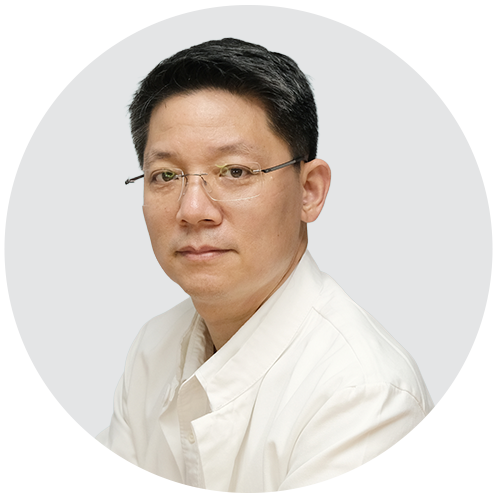
Assistant Professor Dr Parit Wongphaet, Rehabilitation Medicine Specialist at Mahidol University, and Managing Director of TMGI Co., Ltd., emphasises that a critical step is to debunk public misconceptions about sarcopenia, “Sarcopenia is not merely a loss of muscle mass, but a combination of reduced muscle mass, muscle strength and physical performance. Balance impairment is a primary abnormality of the condition rather than a downstream consequence. As a result, falls frequently result in hip fractures, which carry long-term functional disability and up to 20% mortality rate within one year.”
Bridging the accessibility gap
Thailand utilises a mix of grassroots public health networks and targeted clinical interventions to address these issues. The country’s vast rural and urban volunteer network, which was first mobilised during the COVID-19 pandemic, has been leveraged to deliver preventive care at the community level. Municipalities have also established local health centres and “elderly schools” to foster social contact between the elderly alongside group exercises.
However, the lack of physical infrastructure remains a significant obstacle to integration. Poor pedestrian safety and high traffic density at the street level actively reduce public mobility.
“Older people often find it difficult to travel independently for activities outside the home, so those opportunities need to be brought closer to them. Whether in Bangkok or rural areas, the most practical approach is likely to combine telehealth, community volunteers and existing grassroots health networks. The platform is already there; what is still lacking is widespread and consistent access,” highlights Dr Parit, who developed the “Soong Wai Mai Lom” (Seniors Do Not Fall) method in 2011, a clinical breakthrough in fall prevention.
Using a bodyweight-supported treadmill that moves at different speeds and directions, this intervention helps reduce fear of falling while improving balance. According to the ASEAN Journal of Rehabilitation Medicine, the programme successfully reduced fall rates from 66% to 95% at six-month-follow-ups, among elderly cohorts. By 2022, it was implemented in 27 health and medical institutions worldwide and had served more than 1,000 older people.
Local systemic challenges
Scaling preventive health in Thailand also fails because of a lack of individualisation, not awareness.
Dr Parit explains, “Exercise as medicine means prescribing the right type of exercise, at the right consistency and interval, aimed at a defined outcome. The current practice is based on a population average of 'a certain number of minutes a week at a certain intensity'. It is not individualised, and cannot be easily applied onto different lifestyles, routines and households, which is where it fails in practice.”
He also sees Thailand’s Universal Health Coverage (UHC) as giving rise to an unintended behavioural challenge when it comes to preventive health. “While widely regarded as one of the country’s major public-health achievements, guaranteed access to essential care can, for some individuals, reduce the perceived urgency to take preventive action before illness develops.”
AI & personalisation
To bridge the gap between scarce clinical resources and vast community needs, community-led execution must blend together with digital innovation. Thailand faces a severe shortage of physiotherapists, and artificial intelligence (AI) could provide a solution by facilitating remote supervisions together with community-based nurses and volunteers.
Says Dr Parit, “Automated supervision of the “Soong Wai Mai Lom” system is an attractive, cost-effective way to scale interventions without overloading healthcare staff. Three core functions could be managed as an extension of the existing platform: screening, to decide who is at risk and which programme suits them; progression, to judge when a person is ready to climb to the next rung of the ladder; and safety, to flag pain, unusual fatigue or missed sessions early.”
Crucially, the digital evolution must remain equitable. “If a programme requires an expensive wearable, it excludes exactly the vulnerable populations we are trying to reach. For people with limited means, the system must work on quick self-entry and the functions should already be built into an ordinary mobile phone, for example, using the camera and default applications. Anything more should be optional,” opines Dr Parit.
Both Singapore and Bangkok demonstrate that sustainable healthcare cannot survive on reactive treatment. Singapore’s approach highlights the power of systemic policy integration, while Bangkok’s reliance on volunteer networks and specialised, low-cost clinical innovations demonstrate how targeted grassroots efforts can help circumvent some urban infrastructure constraints. By designing interventions around the financial, physical and social realities of everyday life, both hubs are working to ensure that longer lives are also healthier, more active ones.


Comments